
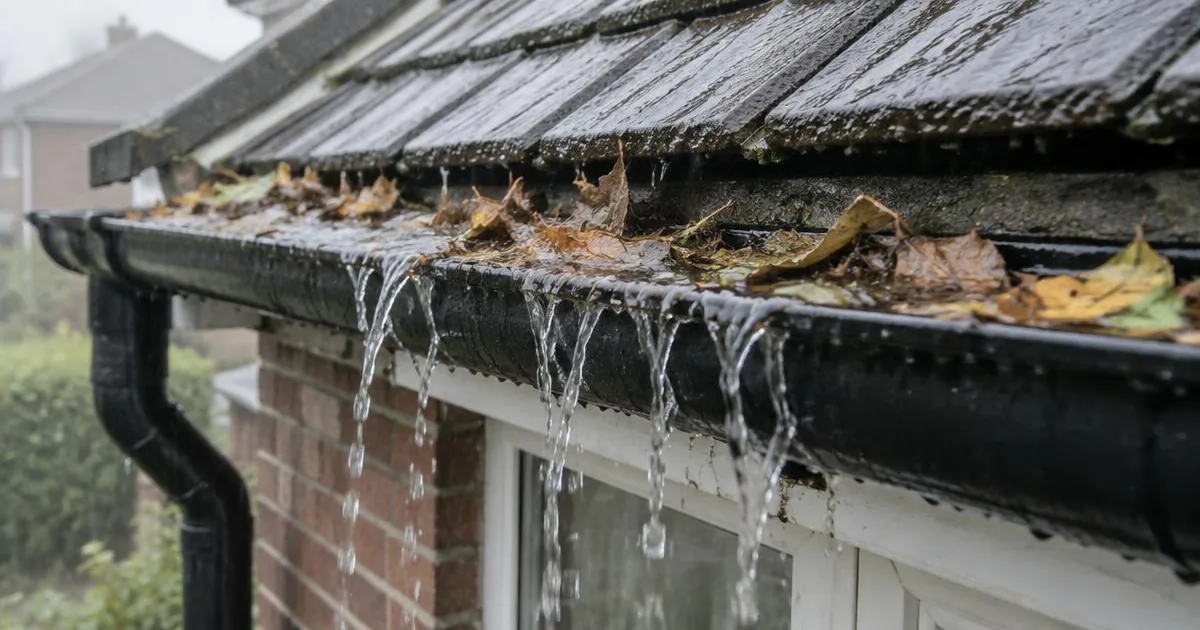
Overflowing gutters are most commonly caused by a blockage or by water being unable to move freely through the guttering and downpipes.
Leaves, moss and other debris are common causes, but overflowing water can also indicate damaged guttering, an incorrectly positioned section, a blocked downpipe or unusually heavy water flow from the roof.
Although it may look like a minor nuisance, persistent overflowing can allow water to run onto walls, fascias, soffits and areas around the edge of the roof.
Here are the main causes — and what you should look for.
1. Leaves and debris are blocking the gutter
This is one of the simplest causes.
Gutters naturally collect:
- leaves
- moss
- twigs
- grit
- fragments of roofing material
- other wind-blown debris
As this material builds up, the space available for rainwater becomes smaller.
Eventually, water can no longer flow properly and begins spilling over the side.
The problem may only become obvious during heavy rain.
2. Moss has washed down from the roof
Moss growing on tiled roofs can become detached and collect in guttering.
Small amounts may gradually build into a much larger blockage, particularly around:
- outlets
- corners
- joints
- downpipe entrances
If you are regularly finding substantial amounts of moss in the gutter, it may be worth checking both the guttering and the general condition of the roof.
3. The downpipe is blocked
Sometimes the gutter itself looks relatively clear but the downpipe cannot carry the water away.
A blockage can form from:
- compacted leaves
- moss
- debris
- dirt
- material entering from the gutter
A clue is water collecting around the outlet before overflowing nearby.
4. The gutter has moved or is sagging
Guttering needs to direct water towards its outlet.
If a section has:
- dropped
- twisted
- pulled away
- lost support
- developed a pronounced sag
water may begin sitting in the wrong place rather than flowing towards the downpipe.
This can result in overflowing even where there is no significant blockage.
5. A gutter joint is leaking
Not all water coming from a gutter is actually overflowing over the top.
A failed joint can create a concentrated drip or stream of water from underneath.
Look for water escaping from:
- connections between sections
- corners
- outlets
- stop ends
A failed seal or movement between components may be responsible.
6. The guttering has been damaged
Gutters can become damaged by:
- ladders
- falling branches
- severe weather
- impact
- ageing
- failed brackets
Cracks, distortion or detached sections can all affect drainage.
After storms or strong winds, it is worth looking along the roofline for obvious changes. See our guide on what to check after high winds or a storm.
7. The rain is unusually heavy
During exceptional rainfall, a gutter may temporarily receive more water than it can move away immediately.
An occasional overflow during extreme conditions is different from guttering that spills water every time it rains.
If overflow occurs repeatedly in ordinary rainfall, there is likely to be another issue worth investigating.
Why does overflowing guttering matter?
Water should be carried away from the roof and property in a controlled way.
If it repeatedly spills over the gutter, it may affect:
- fascias
- soffits
- brickwork
- render
- external walls
- areas around windows
- roof edges
Persistent moisture can create staining and deterioration.
It can also make identifying other roofing problems more difficult because the resulting damp may appear similar to a roof leak.
Can blocked gutters cause a roof leak?
They can contribute to water problems around the roof edge.
If water cannot drain away properly, it may overflow or collect where it should not.
However, a damp patch close to an outside wall is not proof that the gutter is the cause.
Other possibilities include:
- damaged tiles
- flashing defects
- roofline problems
- external wall defects
If water is appearing inside the property, the wider area should be assessed rather than automatically assuming the gutter alone is responsible. For more detail, read: Why Is My Roof Leaking? Common Causes and What to Do Next
Why are my gutters overflowing in one particular place?
A repeated overflow at the same point can provide useful clues.
Check whether the location is close to:
- a downpipe
- a gutter joint
- a corner
- a sagging section
- a roof valley
- an area where several roof slopes direct water together
A large amount of rainwater may be concentrated into a relatively short section of guttering.
What does it mean if water sits in my gutter after rain?
A small amount of residual water may not necessarily indicate a serious problem.
However, significant standing water can suggest that the gutter:
- does not fall correctly
- has sagged
- is being obstructed
- has moved on its brackets
Water should generally be able to travel towards the outlet rather than sitting permanently in a low point.
Can overflowing gutters damage fascias and soffits?
Persistent water exposure can affect materials around the roofline.
Fascias and soffits help finish and protect the edge of the roof.
If water repeatedly spills onto them rather than entering the drainage system, staining or deterioration can occur over time.
This is particularly worth addressing if timber components are involved.
Can I clean the gutters myself?
That depends on whether they can be accessed safely.
Working from ladders or at roof height carries obvious risks.
For easily accessible low-level drainage, homeowners may sometimes be able to remove visible debris safely.
For normal house guttering at roof height, appropriate access equipment is important.
When should guttering be repaired or replaced?
A blockage does not mean the guttering needs replacing.
Cleaning may be all that is required.
Repair may be appropriate where there are:
- failed joints
- damaged brackets
- isolated cracks
- local movement
Replacement may be more sensible where guttering has become widely:
- brittle
- distorted
- badly damaged
- poorly supported
- unreliable in several locations
As with roof repairs, the condition of the complete system should guide the decision.
What should I check during heavy rain?
Rainfall provides the easiest opportunity to see how drainage is actually performing.
From a safe location, look for:
- water spilling over the front
- leaks from joints
- water behind the gutter
- downpipes backing up
- unusual waterfalls at corners
- water running down walls
Observe from ground level and check more closely later when conditions are safe.
Guttering, fascias and soffits in Northumberland
Hewitson Roofing is based in Blyth, Northumberland and carries out guttering and associated roofline work throughout Northumberland and surrounding parts of the North East.
We can help with issues involving:
- overflowing guttering
- damaged gutters
- leaking joints
- gutter replacement
- fascias
- soffits
- roof-edge problems
- associated roofing defects
If overflowing water is accompanied by a leak inside the property, we can also assess whether the problem originates from the drainage system or the roof itself. You can also check the areas we cover or contact Hewitson directly.